

Why Is My Business Not Growing?
If you’ve found yourself asking that question, you’re not alone.
Maybe you’ve invested in a new website.
You’re posting on LinkedIn.
You’ve tried SEO.
You’ve run ads.
You’ve asked for referrals.
You’re working harder than ever, yet the business still feels stuck.
Revenue has plateaued.
Enquiries are inconsistent.
Growth feels harder than it should.
After working with hundreds of owner-led businesses over the last fifteen years, I’ve noticed something.
When business owners ask why their business isn’t growing, they are often looking at the symptom rather than the cause.
That is why doing more rarely solves the problem.
Most Businesses Don’t Have a Growth Problem
They have a bottleneck.
Something inside the business is quietly limiting everything else.
It could be your positioning.
Your offer.
Your marketing.
Your sales process.
Your systems.
Or sometimes, it is the owner.
Until that bottleneck is identified and removed, adding more activity rarely changes the outcome.
More marketing will not fix unclear positioning.
More leads will not fix poor conversion.
A new website will not fix an offer people do not understand or want.
Hiring more people will not fix a business that lacks clear systems.
The bottleneck always wins.
Find it.
Fix it.
Then look for the next one.
Why More Activity Rarely Creates Growth
One of the biggest mistakes business owners make is assuming growth comes from doing more.
More content.
More networking.
More advertising.
More services.
More hours.
But activity and progress are not the same thing.
You can spend sixty hours a week working incredibly hard and still fail to move the business forward.
Equally, one well-judged strategic change can unlock the next stage of growth.
The businesses that grow fastest are not always the busiest.
They are usually the clearest about what is holding them back.
The Three Bottlenecks That Stop a Business Growing
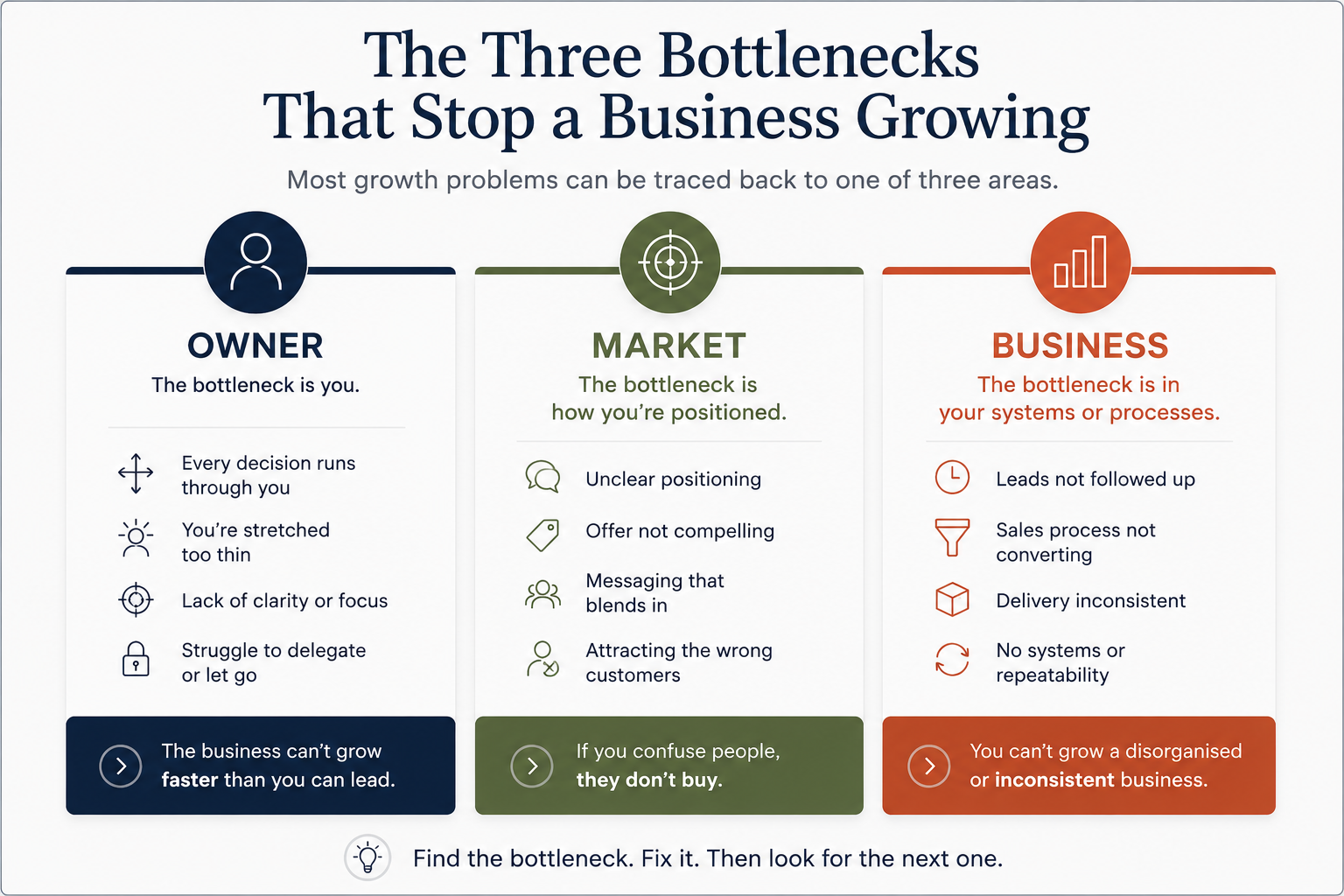
Most growth problems can be traced back to one of three areas.
1. The Owner
Sometimes the owner is the bottleneck.
Every decision runs through them.
They are responsible for sales, delivery, marketing, recruitment and problem-solving.
The business cannot move faster because everything depends on one person.
This is not necessarily a criticism.
It is often a sign that the business has outgrown the way it was originally built.
The owner may need clearer priorities, better systems, stronger delegation or more confidence in the decisions they are making.
2. The Market
Sometimes the problem is how the business is positioned in the market.
The offer may be unclear.
The messaging may sound like everyone else.
The business may be trying to appeal to too many different people.
Potential customers may not understand what makes it different or why they should choose it.
If you confuse people, they do not buy.
Marketing does not fix that.
It amplifies it.
More marketing into confusion simply means more people discover the confusion.
3. The Business
Sometimes the bottleneck sits inside the business itself.
Leads are coming in, but they are not followed up consistently.
Sales conversations happen, but there is no clear process.
Customers buy once, but there is no retention strategy.
The team is busy, but nobody is clear about priorities.
Work is being delivered, but the systems are inefficient or entirely dependent on one person.
In these situations, the business may not need more demand.
It may need to become better at handling the demand it already has.
Start With Clarity
I genuinely believe most business problems are misdiagnosed.
Every business owner can usually tell you what they think the problem is.
“We need more leads.”
“Our website needs replacing.”
“Our SEO is not working.”
“Our competitors are beating us.”
The interesting part comes when you dig a little deeper.
Quite often, none of those things are the real problem.
Businesses leave clues everywhere.
In the language customers use.
In the questions prospects ask.
In the leads that fail to convert.
In the tasks the owner cannot let go of.
In the work the team repeatedly gets stuck on.
In the marketing that creates attention but no action.
The clues are usually there.
The challenge is seeing them clearly when you are inside the business every day.
Clarity, Growth and Control
That is why I think about business in three stages.
- Clarity
- Growth
- Control
Not because the words sound good together, but because that is usually the order progress happens in.

Clarity
Clarity means understanding what is really holding the business back.
Not the obvious symptom.
The underlying cause.
Who do you actually help?
What problem do you solve?
Why should someone choose you rather than the other businesses they could contact today?
What is the one constraint that is currently limiting progress?
Until those questions are answered, everything else becomes harder than it needs to be.
Growth
Growth comes from removing the next constraint.
Once the business is clear about who it helps, what it offers and what needs fixing, growth becomes more straightforward.
Your marketing has something meaningful to amplify.
Your website has a clear job to do.
Your sales conversations become easier.
Your team understands what good looks like.
Growth stops feeling random.
It becomes intentional.
Control
Most business owners say they want growth, but growth is rarely the final goal.
What they really want is control.
Control over their time.
Control over their finances.
Control over how customers experience the business.
Control over what happens when they are not there.
The ability to take a holiday without checking their phone every ten minutes.
The confidence that enquiries will continue to come in next month and the month after.
The freedom to leave work at five o’clock and spend time with their family without feeling guilty.
Growth is simply the vehicle that helps them get there.
Why Business Problems Are Easy to Misdiagnose
Every business problem wears a costume.
A leads problem may really be a positioning problem.
A marketing problem may really be a clarity problem.
A sales problem may really be an offer problem.
A systems problem may really be an owner-dependency problem.
A website problem may really be a messaging problem.
If you solve the wrong problem, you can stay busy for months without making meaningful progress.
That is why I spend less time looking immediately at tactics and more time looking for the constraint.
The thing quietly limiting everything else.
Because once you find it, the path forward usually becomes much clearer.
What Should You Do If Your Business Is Not Growing?
Do not begin by asking what else you can add.
Ask what is currently getting in the way.
Start with these questions:
- Are we clear about exactly who we help?
- Is our offer easy to understand and easy to buy?
- Does our marketing create the right kind of enquiries?
- Are we converting enough of the opportunities we already have?
- Are customers staying, returning or buying more?
- Is the business too dependent on the owner?
- What problem keeps appearing despite our efforts to fix it?
You do not need to fix everything at once.
You need to identify the bottleneck that matters most right now.
Then fix that first.
The Goal Is Not Just a Bigger Business
The goal is to build a better one.
One that is clearer.
One that grows more consistently.
One that does not rely on constant firefighting.
And one that gives you more control over the life you were trying to create when you started the business in the first place.
Clarity.
See what is really holding you back.
Growth.
Remove the next bottleneck.
Control.
Build a business you lead, rather than one that leads you.
Still Not Sure Why Your Business Is Not Growing?
When you are inside your own business every day, it can be difficult to see the real problem clearly.
You are often too close to the decisions, the pressures and the day-to-day work.
My Business Breakthrough Session is designed to help you step back, identify the bottleneck and decide what needs to happen next.